
Introduction
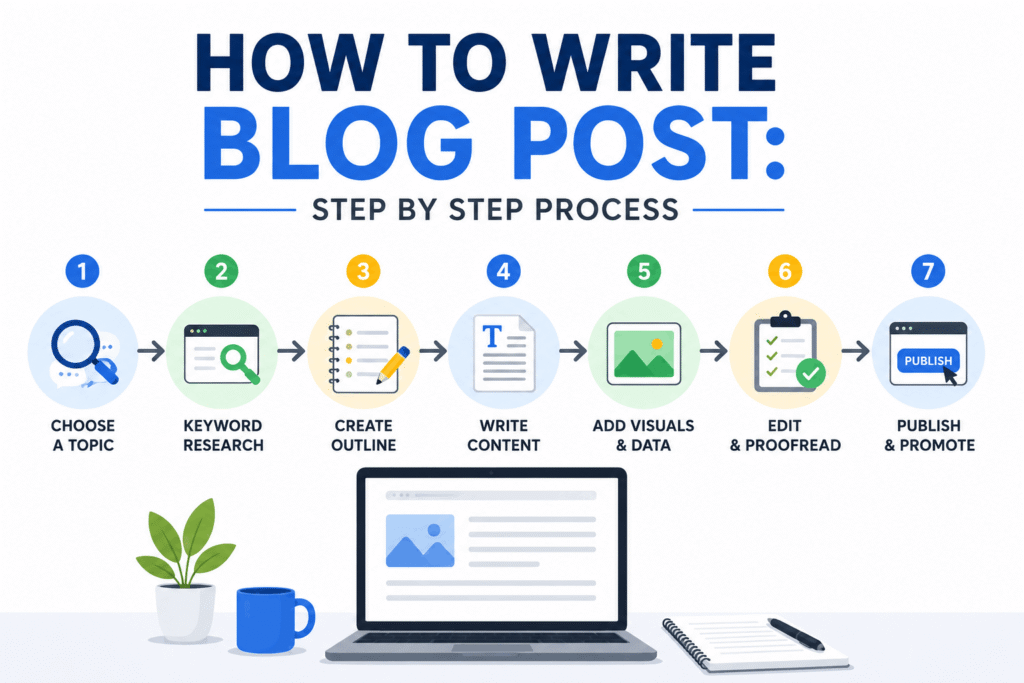
How to write a blog post is something that brings a lot many confusion to the people at large and it does not seem as simple as just writing an article as it requires certain skills, interactive temperament, inquisitive mind and innovative approach. A great blog post should have a clear and well-defined structure commencing with an engaging and compelling hook and concluding with a strong CTA (Call to Action). The other key factor is a perfect blog post structure providing a framework that works and it may be discussed as;
- A CLEAR TOPIC: Identify a topic with clear objective as to what the audience cares about and wants solution.
- KEYWORD RESEARCH: Make a comprehensive research to know what the audience types the terms on the search engine for better visibility.
- A WELL-DEFINED OUTLINE: The main points should be listed and subheadings should be defined before writing the blog post.
- A CATCHY TITLE: The title should be attractive and attention grabbing as it must show real value to the reader.
- A COMPREHENSIVE INTRODUCTION: The readers’ attention should be hooked in the very outset by defining what is being presented in the post with a clear introduction.
- A BODY TEXT: The body text should be put in a clear structure with short paragraphs and bullet points making it easy for the readers to skim up information.
- VISUALS: The relevant pictures and graphics should be added to break the monotony of the drab text.
- CONCLUSION: The points should be summarized with call-to-action (CTA) like leave a comment.
- EDIT AND PUBLISH: The post should be thoroughly reviewed for editing and then should be published.
HOW TO WRITE BLOG INTRODUCTION THAT HOOKS THE READERS
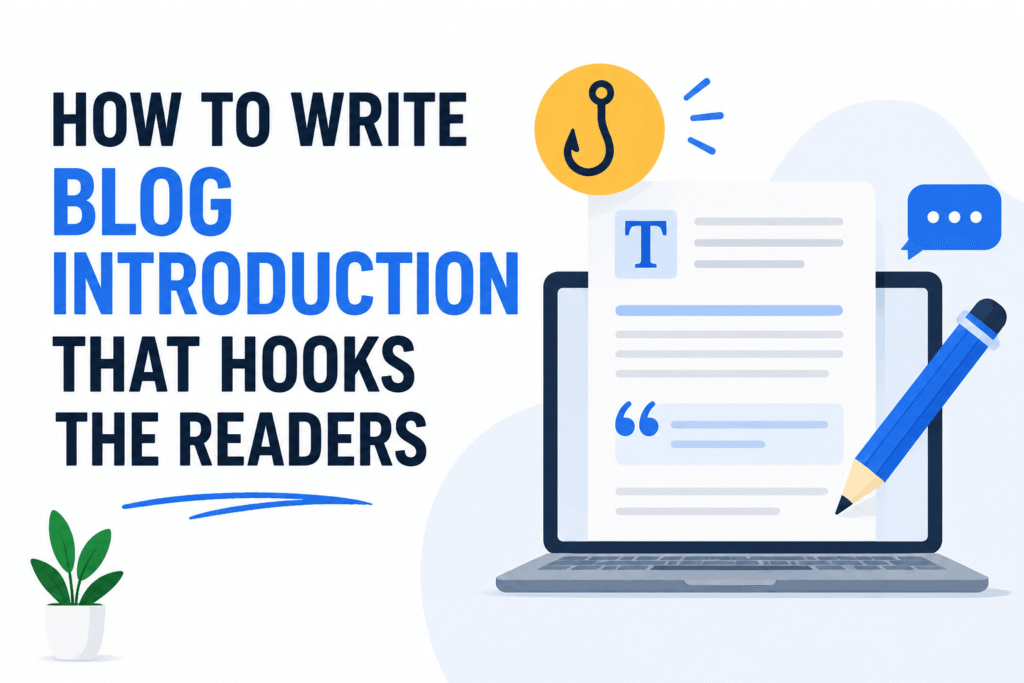
The introduction of the blog post should be catchy, inspiring and eye-grabbing with short and punchy sentences that have the quality to glue the readers’ attention. The information with problem-solution methodology and explanation what they will gain while going through the blog post should be an integral part of the introduction. The opening lines should be aligned in smart and brief setting making it easy to scan.
KEY POINTS TO WRITE HOOKING INTRODUCTION
- PUT A QUESTION: The readers’ attention should be hooked with a question regarding the familiar struggle as it makes them think.
- FACT SHARING: The facts and figures should be shared by presenting them in bold statistics.
- TELL A TALE: A personal or customer’s experience should be shared for value ad authority
- BE UNIQUE: The out-of-box solution, a new idea and a unique concept should be made part of introduction.
HOW TO WRITE A BLOG OUTLINE
Writing an accurate and strong blog post outline requires researching the targeted keywords, identifying the users’ intent, drafting a workable headline, curating logical H2 and H3 subheadings, adding key bullet points or examples for each section and concluding the post with clarity and a vivid call-to-action (CTA). The HubSpot Blog provides deeper and structured framework with a comprehensive guide.
KEY STEPS TO STRUCTURE OUTLINE
- RESEARCH AND INTENT: The top-ranking post should be researched for quality keywords to find the intent and look at the information the readers require. For key word research, use GOOGLE RESEARCH TOOL, AHREFS or SEMRUSH.
- CLEAR TITLE: The title should be well-defined, well-thought-out and clear having main keyword.
- ENGAGING INTRODUCTION: The opening lines should be engaging and attractive with solution to readers’ problems as this type of introduction hooks the readers.
- H2 AND H3: The main section heading (H2) should be well-defined and smaller subheadings (H3) should be accurately adjusted.
- BULLET POINTS: The bullet points, statistics or examples should be added to give the blog post value and authority.
- CONCLUSION WITH CTA: The blog post should be concluded with a summary elaborating main points and readers should be inspired to call-to-action (CTA).
WHAT IS IDEAL BLOG POST LENGTH FOR SEO?
The ideal length of the blog post for SEO should be between 1,500 and 2,000 words. Though the word count and length have nothing to do with the Google ranking factor, the long form content offers depth and insight required to thoroughly respond to user intent query as it helps in incorporating the keywords naturally in the text and getting backlinks.
However, Reddit has a different view as many believe in content value and depth which may satisfy the users’ quest rather than focus on word count and length.
KEY FACTORS ABOUT BLOG POST LENGTH
- SHORT FORM/QUICK UPDATES (300-800 WORDS): This word count is considered excellent for simple news and limited queries.
- STANDARD BLOG POST (1,000-1,500 WORDS): The standard length of blog post is excellent for specific analysis or topics with low competition.
- COMPREHENSIVE GUIDE (1,500-2,500 WORDS): The blog post with long narrative input is perfect for outranking the competitors on informational keywords.
- PILLAR CONTENT (3,000+ WORDS): The pillar content offers comprehensive information covering the topic from all the angles.
POINTS NECESSARY TO BE CONSIDERED
- SEARCH INTENT: The content should be written matching the users query avoiding unnecessary padding.
- COMPETITORS’ ANALYSIS: The competitors’ pages on top rank should be analyzed and put the content better than the competitors in length and value.
- READABILITY: The content should be well-structured with listicle setting giving subheadings and bullet points and managing it with clear formation so it remains easy to skim.
Explore a data-backed analysis from Search Engine Journal.
Go through content depth perspective from Yoast..
HOW TO WRITE BLOG CTA (CALL TO ACTION) STRATEGY THAT CONVERTS READERS INTO SUBSCRIBERS
 The specific object with single, clear and vivid goal per post is necessary for converting the readers into subscribers. The post should be benefit-driven like ‘Get the free checklist,’ as the content should match the readers’ intent. The high contrast CTAs should be placed in-line and at the end of the content.
KEY FACTORS OF CTA STRATEGY
- SINGLE GOAL: A blog post must contain one objective as the readers should not be asked to share, comment, make purchase and subscribe all at once.
- ACTION-DRIVEN COPY: The strong commanding verbs should be used and vague phrases like ‘Click here’ or ‘Submit’ should be replaced with precise beneficial phrases such as ‘Send the weekly tips’.
- MATCHING INTENT: The top of funnel freebies should be offered like checklists, cheat sheets or short guides which give instant solution to issues related to the article.
DESIGN AND PLACEMENT
- INLINE LINKS: The body text should contain text links or contextual boxes where engagement is the highest.
- STRATEGIC POSITION: Soft CTA should be added near the top, an inline offer in the middle and a final prompt at the end of the post.
- VISUAL CONTRAST: The buttons should have prominent colors giving a contrast from the blog background and empty white space should be left around the button to grab the attention.
HOW TO WRITE EVERGREEN BLOG CONTENT THAT RANKS FOR YEARS
Writing an evergreen blog content that continues to rank for a longer period is something that requires a lot of research, an analytical approach and specific intent with steady and consistent strategy. The foundational questions should be targeted avoiding time-bound, time-sensitive and yearly timelines.
The blog post must contain comprehensive guide and how-to-tutorials and data and examples should be refreshed now and then.
KEY FACTORS OF EVERGREEN BLOG
- INDUSTRY FOCUS: The focus should be on the industry basics as the core issues should be kept in mind to ensure the long term validity of the blog.
- NO TIME BOUND REFERENCES: The temporary news, pop culture references and time bound statistics should be avoided.
- PROVEN FORMAT: The format like step-by-step tutorials, glossaries and ultimate guides should be ensured.
- KEYWORD AND INTENT RESEARCH: The keyword tools should be used to search for stable, high volume search queries and to determine the intent.
- ORGANIC AUTHORITY: The organic authority should be developed over the time by using long-tail keywords.
- USER INTENT: The user intent should be matched by answering what the readers want or fix.
WRITING PREFERENCES
- The sentences should be kept brief and short in active voice avoiding heavy jargons and slangs.
- The text should be structured with clear headers, bullet points and practical instances.
- The readers should be provided with complete answers.
HOW TO WRITE BLOG CTA STRATEGIES THAT CONVERT READERS INTO SUBSCRIBERS
Three main points should be an integral part of writing high converting blog CTAs (Calls-to-Action) such as clear value, strong and prominent placement and simplicity in design.
KEY CONVERTING STRATEGIES
- CLEAR OFFER: The readers should be informed clearly what they want like a free guide or weekly tip list following subscription.
- STRONG ACTION WORDS: The button text should be started with strong words like ‘Get’, ‘Join’ or ‘Download’ instead of unclear words like submit.
- CTAs WISE PLACEMENT: The CTAs should be placed wisely at appropriate place inside the content, end of the post and in a sticky sidebar.
- SHORTER FORM: The signing up should be made easy and fast by asking only for email address.
HOW TO WRITE LISTICLE POST THAT RANKS AND SHARES
The listicle posts are high performing written pieces as they are structured with list-friendly topics, numbered headers like H2/H3 for every item and front load of the main topics.
KEY POINTS OF LISTICLE POSTS
- CLEAR TOPIC: The topic should be chosen where the users want comparisons and quick answers.
- STRONG NUMBERS: The headlines should be given with numbers and compelling words.
- FRONT LOAD TOP ITEMS: The most important points should be placed near the top to hook the readers.
HOW TO WRITE CASE STUDY THAT BUILDS AUTHORITY

Credibility and trust make the fundamental of the business and a case study is a workable strategy to build reliability among the audience and customers. The case study is not limited to telling the people what has been done rather it requires problem solving mechanism of the businesses.
The case studies show real success stories providing expertise and reliability without a massive marketing budget. The core structure of case study includes defining the problem with unique solution and measurable results.
KEY POINTS OF WRITING CASE STUDY
- RIGHT CLIENT: A prominent success story should be selected that shows ideal target audiences’ pain points.
- TALK TO USERS DIRECTLY: The people who have used the products or services in real time should be interviewed to make a perfect case study for the ordinary users.
HOW TO DEVELOP NARRATIVE FOR CASE STUDY
- HERO’S JOURNEY: The user should be given a hero status and the company should act as a guide that has provided the roadmap.
- CLEAR CHALLENGE: The specific problems, challenges, obstacles and stakes should clearly be elaborated as to how the client has come across before working with the company.
- TRANSPARENT SOLUTION: The well-defined strategy, decision-making process and priorities regarding the specific path should explicitly be defined.
CONCLUSION
The blog post that fulfils the requirements of the readers, acts as a key factor in website ranking, engages the audiences, provides the readers with relevant information and solution, leads them to the key point of subscription with strong calls to actions (CTAs), contains valuable analysis, shows well-structured format and listicle approach is something that is the basic point to remain in the run over the online searches. A good, reliable and valuable blog post acts as a catalyst that writes the success stories for the website and helps in keeping the ball rolling in the highly competitive and challenging world of the businesses.
FAQs
How should topic of blog post be picked?
Ans. The target audience searches be analyzed for picking a good topic to write a blog post.
Is an outline of blog post necessary?
Ans. An outline of a blog post should be used as it saves time and keeps the writing well-organized.
How often should blog posts be published?
Ans. The value is more important than the number of posts however, one or two posts in a week are enough.